

A summary of the evidence on streetlighting and crime, and what cities should do differently
This is the summary overview of the problem and solutions in Rubber Meets Road: Lighting, a Vital City-Center for Justice Innovation series on what New York can do to make its streets safer by lighting them better. The series also includes a summary of the Rubber Meets Road project, a detailed policy primer, Aaron Chalfin on 50 years of research, a design deep-dive on what well-lit streets should feel like, maps showing where darkness and 311 lighting complaints overlap with crime, and a proof-of-concept mobile app for reporting dark blocks.
Street lighting
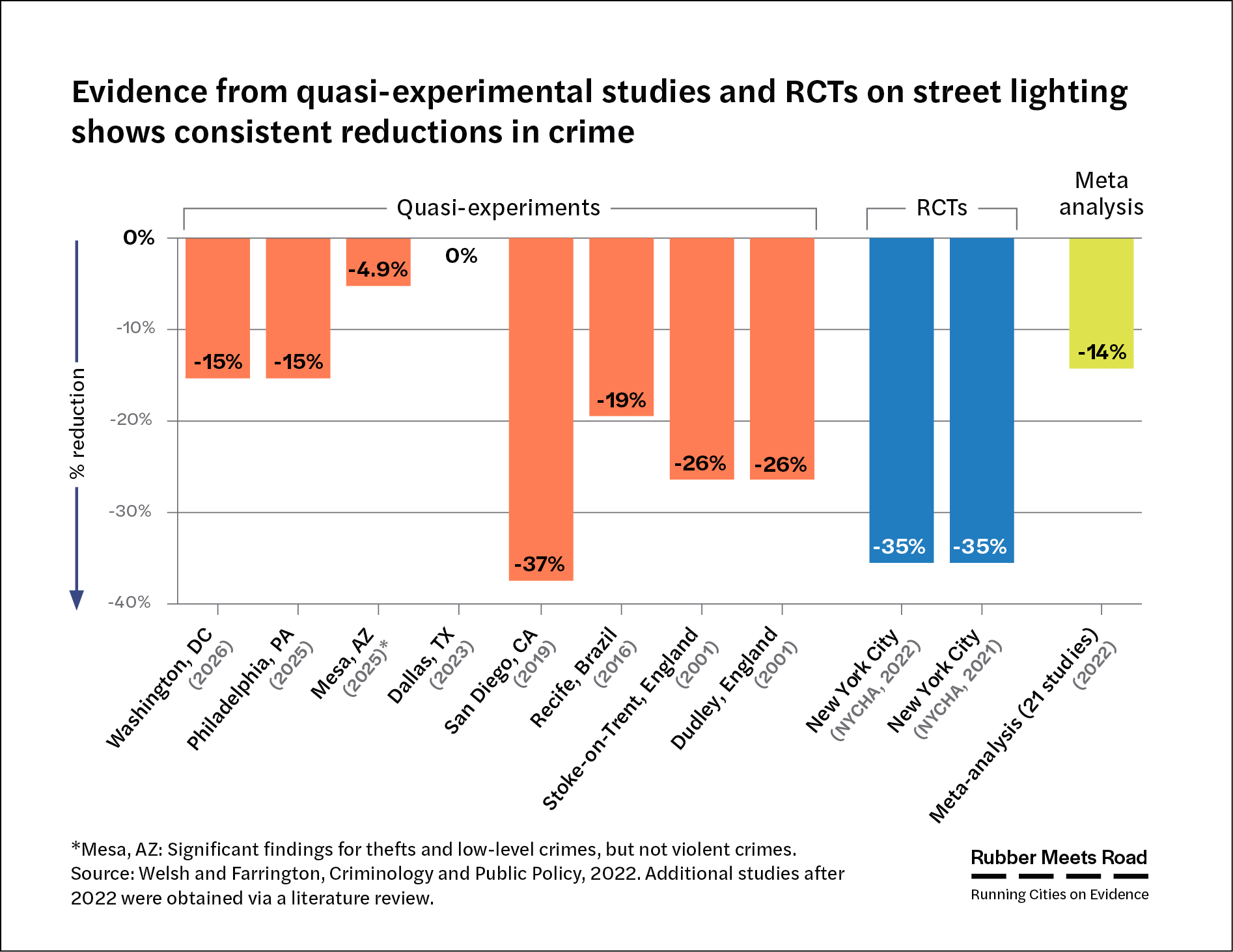
Crime goes up when the sun goes down. This is true in cities across the globe. But street lighting can change that — and change it by a lot. In research using the highest standard of proof, a randomized controlled trial (RCT), serious crime in New York City housing developments dropped by 35% when the lights went on. Crime wasn’t displaced to someplace else — it just went away.
Street lighting reduces serious crime in part because people think twice when they know they might be seen and caught. And they’re not wrong: Streetlights ensure that pedestrians and police on patrol are better able to notice and react to threats. But more fundamentally, better lighting means more life on the streets. Lighting creates a virtuous cycle, drawing residents outside to socialize and patronize local businesses, resulting in more “eyes on the street,” which in turn puts the brakes on many forms of bad behavior.
The evidence
Two recent studies have rigorously analyzed how improved lighting can drive down crime. In New York City, researchers identified 80 public housing developments with high crime rates and installed temporary lights in half of them. The new lights reduced outdoor nighttime index crimes by 35%, and the drop in crime occurred without any increase in arrests. Nor did crime simply move to nearby locations.
In Philadelphia, upgrading more than 34,000 streetlights in high-crime neighborhoods to provide brighter and more even light reduced nighttime outdoor crimes by 15% in comparison to neighborhoods where there were no changes in lighting, including a 20% drop in violent crimes and 21% reduction in gun crimes.
These outcomes align with the lion’s share of studies over the past 25 years showing that crime declines when street lighting improves. Learn more by reading Aaron Chalfin's in-depth explanation of the evidence, “50 Years of Evidence,” at Vital City.
A cost-effective strategy
Improved street lighting is easy to implement through existing municipal operations, and it yields immediate results. In New York City, for example, it costs $10,000 to install a single new streetlight (a capital expense if the project exceeds $50,000 within a half-mile radius). This is a fraction of the cost of crime and punishment, and far less expensive than employing additional police officers.
Keys to success
1. Pick the right locations. Serious crime is highly concentrated, often in neighborhoods long passed over for all types of investment.
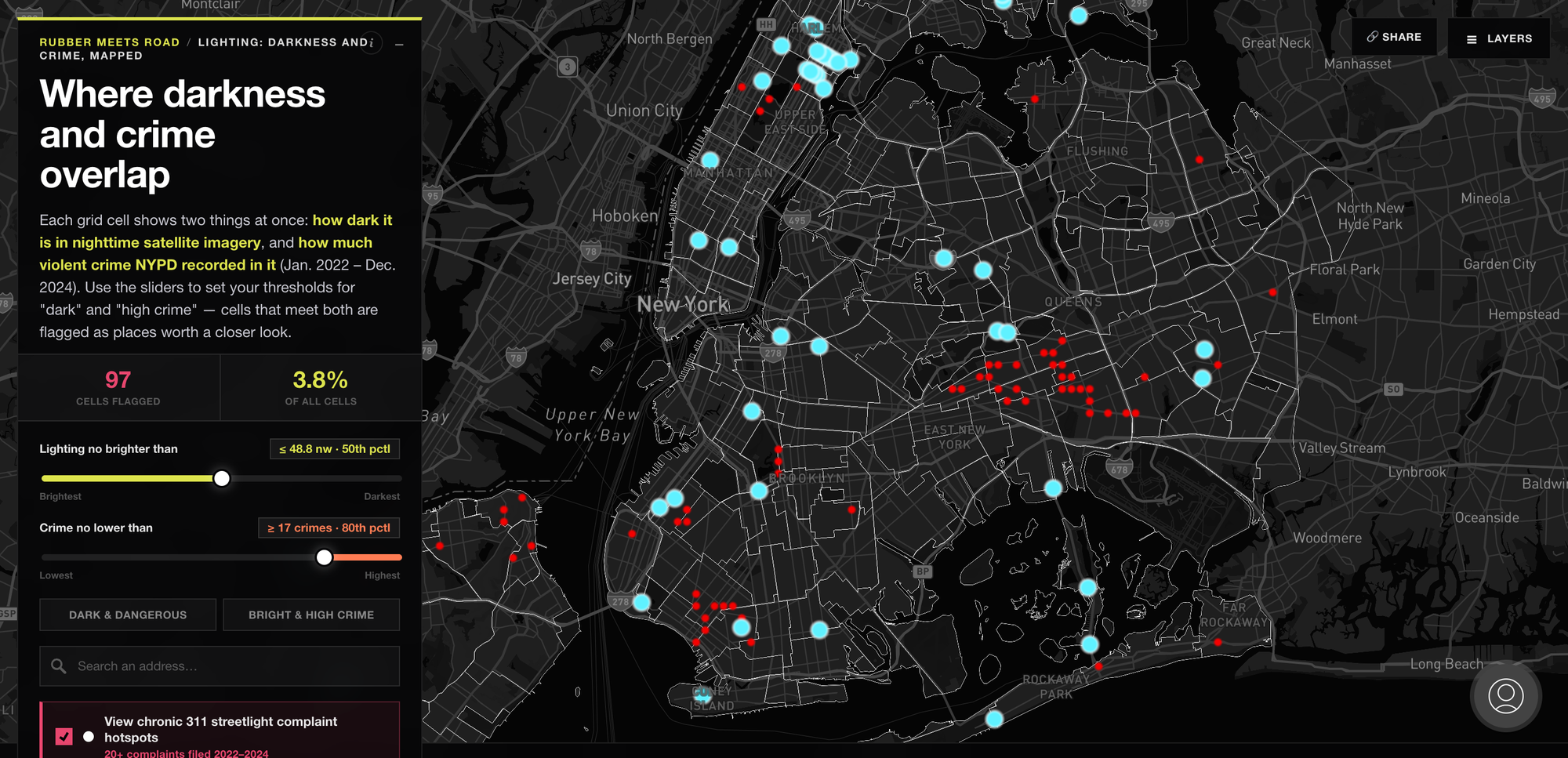
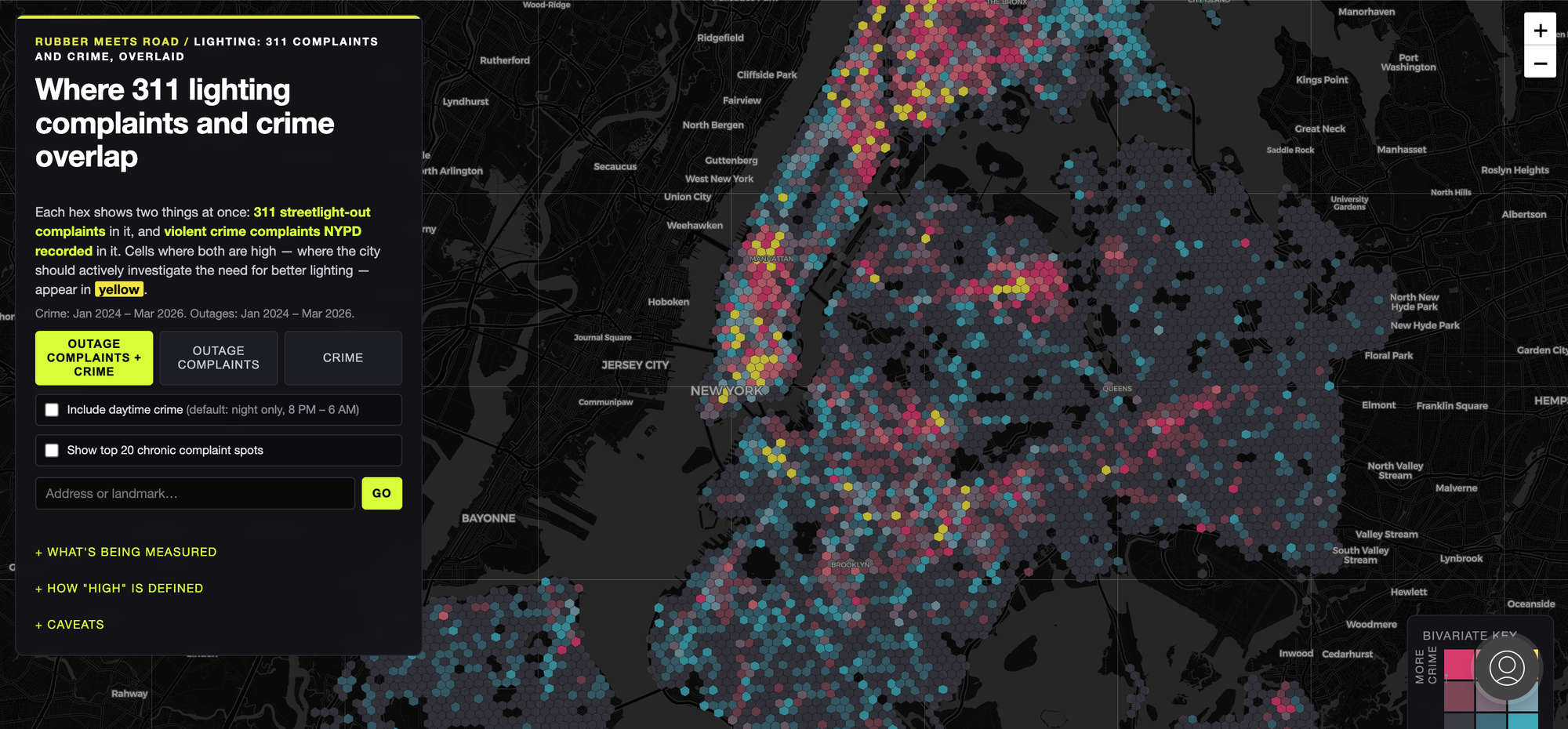
To identify areas of need, this project is debuting a new mapping tool merging crime data with nighttime satellite imagery to spot where darkness and high rates of nighttime violent crime overlap in New York City. A second mapping tool shows the intersection of 311 complaints about broken streetlights and violent crime. But the human eye and experience are key. Cities should incorporate the knowledge of residents and others who are in the neighborhood every day (e.g., sanitation and parks workers and police) to pinpoint the places that feel unsafe and decide on where to install or improve streetlights.
Here’s what Rubber Meets Road’s two mapping tools look like in action.
2. Illuminate a few blocks, not just a corner. While lighting just the dark alley or underpass might seem the most direct approach, the research shows that overly specific targeting has negative side effects. If the alley is lit, but adjacent areas remain especially dim, the people intent on committing crimes may simply slip into the nearby shadows. A better approach is to create an illuminated “buffer zone” around any particular hot spot.
3. Invest in quality lighting. The human eye sees best when light is uniformly distributed. But many city streets have glaring bright lights with dark stretches in between. The effect: Dark areas appear darker and visibility becomes poor. The solution: Rather than installing one overly bright fixture, install several warm and lower-output fixtures, evenly spaced. This approach improves visibility and creates pedestrian-focused spaces that encourage active use. Adding additional lights to existing poles, along with wall-mounted lights on businesses and residences, is another effective strategy. For more on the importance of lighting quality, read Buro Happold, Studio Gang, and Urban Design Forum’s “What Well-Lit Streets Should Feel Like,” composed in consultation with the Pitkin Avenue BID, Youth Ministries for Peace and Justice, and Chhaya CDC, under “Rubber Meets Road” on Vital City’s website.
4. Look beyond lighting. Other changes to the built environment — for example, improving the design of scaffolding (or removing it promptly) and adding street furniture, like chairs or benches, to underused public spaces — may also help prevent crime. While these specific changes to a neighborhood have yet to be rigorously evaluated, research on greening vacant lots and fixing up blighted properties finds that, much like improved street lighting, these sorts of investments can help make neighborhoods safer by revitalizing neglected blocks and generating greater foot traffic.
For more in-depth strategies, read our detailed policy guidance, “Street Lighting: How to Get it Done.”


