

Streetlighting improvement strategies for people who make policy
This is the implementation roadmap in Rubber Meets Road: Lighting, a Vital City-Center for Justice Innovation series on lighting New York's streets to make them safer. Read alongside it: a summary of the Rubber Meets Road project, the summary overview of the problem and solutions, Aaron Chalfin on 50 years of research, a design deep-dive, maps overlaying crime with satellite-measured darkness and 311 outage complaints, and a proof-of-concept app for reporting dark blocks.
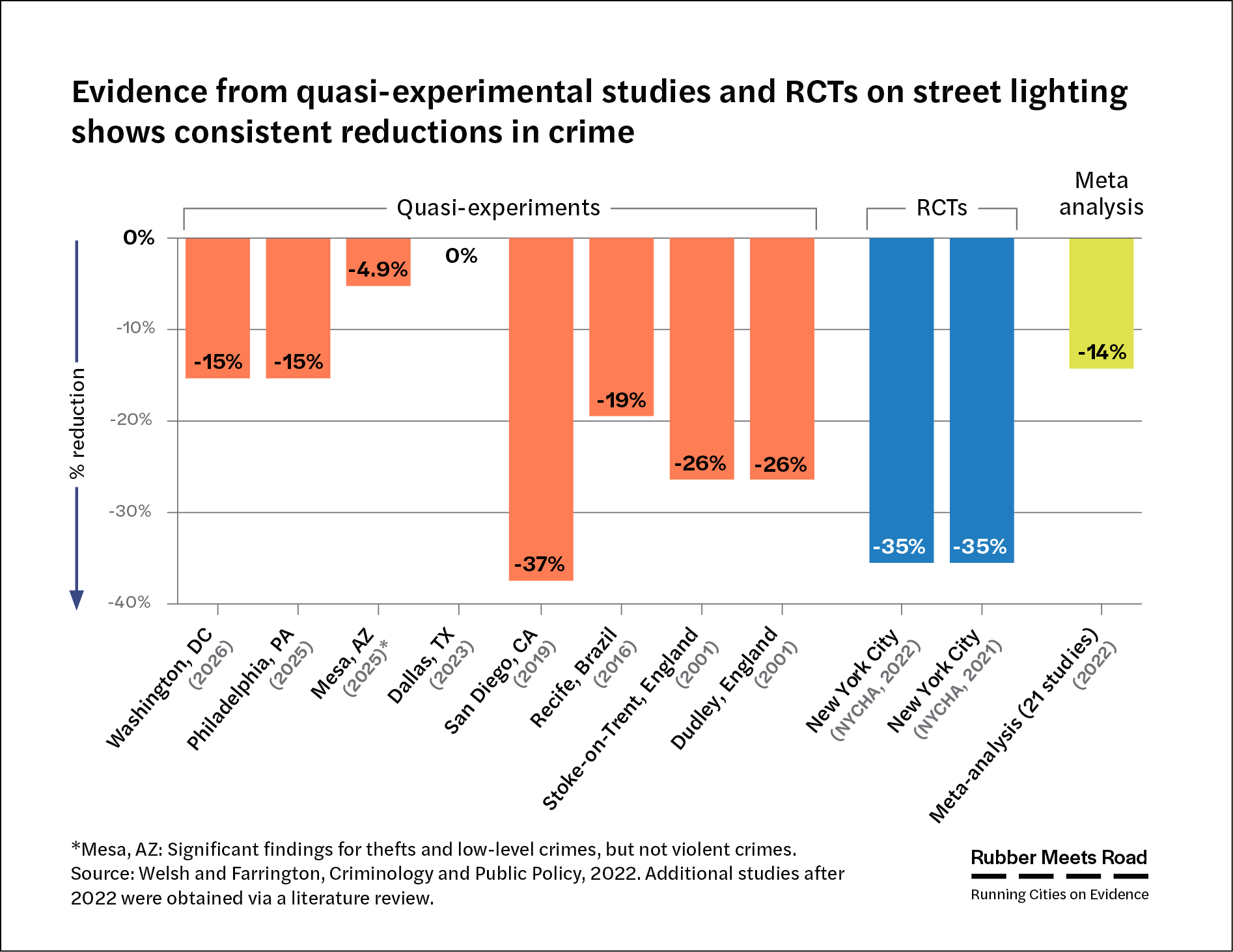
Better lighting on a city’s streets and sidewalks can be a highly effective way to reduce crime — and to bolster civic life at the same time. It’s not just common sense. It’s been tested at the highest level of scientific rigor. In New York City, a randomized controlled trial in public housing showed a 35% reduction in major crime committed outdoors during nighttime hours, with no increase in nearby areas. These reductions were sustained over years. And research in other cities — including Philadelphia and Washington — shows that citywide lighting upgrades have a similar impact.
Lighting is one of a handful of strategies that are twofers. It is a service that cities provide as part of their everyday responsibilities, and it has the added benefit of decreasing crime when smartly deployed. Improving lighting improves public safety without increasing arrests or incarceration.
The power of lighting is rooted in the idea that improving social connections helps make a city safe. Lighting encourages lively public spaces, or, as Jane Jacobs put it, “eyes on the street.” Because the responsibility to provide this service lives outside of a police department — in New York City, primarily in the Department of Transportation — its crime-reducing powers are often overlooked. But with not that much effort and often without that much money, it can be a powerful tool.
This guide for policymakers explains why improving lighting makes cities safer and summarizes the research supporting streetlights as an effective crime prevention strategy. It also outlines important considerations and practical steps for implementing a simple change that yields outsize benefits.
The idea
Changes to the way a city street looks and feels can have a large impact on public safety. Most people stay away from dark alleys but gravitate to well-lit streets. Meanwhile, those looking to commit crimes will see an opportunity — to avoid being seen and caught — in a city’s unlit, neglected places. Overwhelming evidence in city after city over the decades also shows that crime, particularly violence, is highly concentrated in a small number of neighborhoods and even on certain streets within those neighborhoods. And just as reliably, study after study has shown that improving public spaces — whether by lighting or greening vacant lots or fixing up dilapidated buildings — can increase safety and reduce fear among residents.
It’s not just social scientists who understand why lighting is part of the solution. In well-lit environments, people who might otherwise be motivated to commit crimes think twice. Potential victims and police on patrol are better able to notice and react to threats. And perhaps most importantly, lights draw residents outside to socialize with one another and patronize local businesses, which further discourages crime.
The evidence
A review of 21 studies spanning more than five decades of research finds that improved street lighting reduces crime by an average of 14% compared to more poorly lit areas. The strongest evidence comes from New York City and Philadelphia, where recent, rigorous studies documented large reductions in nighttime outdoor violent crime, in New York City by 35% and in Philadelphia by 15%.
In New York City in 2016, researchers identified 80 public housing developments with high crime rates and randomly assigned half to receive temporary lighting towers to illuminate dim or dark internal sidewalks; the other half served as a control group where the lighting was unchanged. The result, as measured in the months that followed: a 35% reduction in felony assaults, robberies and other index crimes (murder, manslaughter, robbery, burglary, grand larceny and motor vehicle theft) outside at night. And crime didn’t simply move around the corner. The study looked for but found no evidence that crime was displaced to other areas.
Critically, the decrease in crime occurred without any increase in arrests — compelling evidence that lighting deters crime and doesn’t widen the net of the justice system. And these weren’t just flash-in-the-pan results. Following up three years later, researchers found that the crime declines had been sustained and arrests had not risen.
More recently, researchers in Philadelphia studied the ongoing rollout of a citywide lighting upgrade. Since summer 2023, the Philadelphia Energy Authority has been working to replace all 134,552 streetlights with new LED fixtures that provide more even illumination (and reduce energy usage and costs). An analysis of the first 34,374 upgraded lights, covering roughly a third of the city and installed disproportionately on blocks with higher crime rates, found a 15% reduction in nighttime street crime, including a 21% reduction in gun violence as compared to areas not yet upgraded. As in New York City, the new lights did not displace crime to surrounding blocks, and the drop in crime occurred without any increase in arrests. The researchers also documented reductions in crime during the day, albeit to a smaller degree.
As more cities embark on citywide lighting upgrades, the evidence has gotten stronger. In Washington, D.C., and Mesa, Arizona, recent studies also found crime reductions following citywide lighting upgrades, with no evidence that crime simply moved elsewhere. In Newark, violent crime fell by 35% within 200 feet of enhanced streetlights (although this effect dissipated after 6 months), with no displacement of crime to other areas, and no reductions observed in similar areas without improved lighting.
For the skeptic, it’s worth pointing to a simple but compelling natural experiment on lighting’s impact on crime: daylight saving time. Twice a year, we move our clocks backward or forward, dramatically changing daylight during certain hours of the day. One day, 7 p.m. is dark — the next day it’s light. Research studies from the United States and Chile demonstrate that when the clocks move forward or back and natural lighting changes, shifts in street crime follow. In a study in the United States, the extra hour of daylight reduces robberies by 7%.
Of course, this doesn’t mean that every single dimly lit area needs brighter lighting — or that every well-lit area is sure to be safe. But when an area is both unsafe and poorly lit, better lighting is a cost-effective approach that pays dividends in safer and livelier streets.
For more information about the body of evidence supporting street lighting as an effective crime prevention strategy, read “50 Years of Evidence,” written for Rubber Meets Road by Aaron Chalfin, associate professor of criminology at the University of Pennsylvania and the nation’s leading researcher on the effect of lighting.
The costs
Streetlights are a standard city service. Each year, cities allocate funds to maintain and repair existing lights and add new ones. For example, the New York City Department of Transportation, the agency primarily responsible for the city’s streetlights, spends roughly $35 million on repairs and $10 million on new installations each year (along with a $60 million energy bill). Maintenance efforts are generally funded by annual expense budgets, while installations draw on longer-term capital budgets (if the project exceeds a minimum threshold of $50,000 within a half-mile radius).
These are large sums, but because these are existing budgetary commitments, using streetlights to reduce crime requires a small shift in mindset, not a big shift in dollars. To start, policymakers could simply add public safety to their list of criteria when deciding where lights should go.
New or improved streetlights can be quickly installed. They have immediate impact, are long-lasting and are inexpensive to maintain. In New York, it costs approximately $10,000 to install a new streetlight and $400 annually to maintain it, and it lasts for 10 to 20 years. And because lighting appears to reduce crime through deterrence (which is cheap) and not through arrest and possible incarceration (which are expensive), it reduces the costs of both crime and punishment, yielding a rare double dividend for strained city and state budgets for years to come. Lighting is especially cost-effective when one factors in the costs of crime to victims, families and neighborhoods, and the costs of investigating crimes and prosecuting and incarcerating offenders.
And the benefits of improved lighting likely extend well beyond quantifiable criminal justice costs — from increased feelings of safety among residents to busier sidewalks and businesses.
Putting the idea into practice
Distilling the research and the wisdom of New York City government officials, urban planners and lighting experts, here is some of the best advice for the real work of improving street lighting.
1. Pick the right locations. Figuring out where dark places overlap with the highest rates of serious nighttime crime starts with looking at the data — what’s well-lit and what’s not, where and what kind of crime is happening, and in what concentrations. Assembling the crime data is relatively straightforward; the lighting data, less so.
To take a first cut, Vital City and the Center for Justice Innovation worked with researchers at NYU to develop a prototype mapping tool that overlays where crime is concentrated (by type) with where the lighting needs work. We then tested the tool with City officials.
The tool tries something new. Using NASA satellite images, it divides New York into 500-by-500-meter squares (roughly 12 city blocks). It then calculates the monthly average nighttime radiance (or surface brightness) and the counts of outdoor nighttime violent crimes for each square. Together, these data give City officials a starting point to zoom in on places where outdoor crime is high and lighting is relatively poor. The tool is also useful for identifying areas where lighting may be adequate but crime is still high, suggesting the need for other interventions.
2. Talk to neighborhood residents. Though the tool provides a pointer, the devil’s in the details. Because the analysis of satellite imagery can only calculate average brightness over a wide area, the tool can’t zero in on problem blocks or show where specific lights should be located. That requires shoe leather.
Neighborhood residents, store owners and government workers who have daily experience in a neighborhood’s streets and parks often know where better lighting is needed. Some of these insights are captured in 311 calls — and we are also releasing a map showing where complaints about street lighting and violent crime overlap. These data have their own limitations, as they are skewed by deeply uneven complaint volumes by neighborhood.
Using these tools’ suggestions as a starting place, the City could conduct lighting audits with residents to identify places where people feel unsafe — such as on dark corners, under scaffolding where views are obstructed and even in places where overly bright lights blind pedestrians and create shadows. Because this work stretches the conventional mandate of the agencies tasked with installing and upgrading streetlights, the City could partner with local community-based organizations with on-the-ground relationships. This kind of work might be incorporated into the neighborhood work that a soon-to-be-created Department of Community Safety, among other City agencies, will be doing. And this work should be documented to ensure cities and researchers learn which approaches lead to successful interventions.
A recent resident-driven planning process in public housing developments in the Brownsville area of Brooklyn, for example, resulted in the installation of supplementary fixtures on light posts that illuminate dark corners and overpasses and also activate underused seating areas.
To support these granular efforts and give both residents and the City an easier way to document lighting conditions, Vital City built a working proof of concept: a browser-based tool that turns a smartphone camera into a rough light meter, geotags readings and walks users through reporting outages to 311. Although just a demonstration, this tool shows how an existing technology could be leveraged to better target maintenance and installation efforts at almost no cost.
3. Illuminate a few blocks, not just a corner. While it is tempting to light just the dark alley or underpass, research suggests that such focused strategies can potentially backfire. Lighting just a corner but not the surrounding area can simply push crime to new locations. A study in the United Kingdom found that when lighting was upgraded on a single street, crime fell there but increased on adjacent streets. Interestingly, the same study also found that when street lighting was intentionally dimmed to reduce costs and carbon emissions, crime moved from the newly dimmed areas to adjacent streets with better illumination. This suggests that some people are willing to commit crimes in illuminated areas where they have more access to potential victims, perhaps especially if they can quickly “disappear” into dark areas nearby. A study of power outages in Chicago reached a similar finding: When streetlights went out, crime migrated from totally dark streets to partially illuminated ones nearby.
These findings suggest that piecemeal improvements are unlikely to be successful.
To avoid simply moving crime from one street to another, policymakers should create illuminated “buffer zones” by improving lighting on the blocks around crime hot spots. The larger the area in which lighting is improved, the lower the chance that crime will be displaced. This approach aligns with the studies in Philadelphia, Washington and Mesa, in which large-scale lighting upgrades reduced crime with no evidence of displacement.
4. Use lights as a complement to, not a substitute for, law enforcement. Given street lighting’s effect on increasing public safety and its low costs and ease of implementation, City officials might consider investing in lighting while reducing spending on law enforcement. Whether policing can be reduced as lighting improves is an unanswered question. It’s also not possible to say with precision how much increased activity on the streets would diminish the need for police presence. Neither question has been specifically addressed in the research, but experts note that police presence has a strong deterrence effect and likely complements lighting. Of all the studies to date on the effect of street lighting, none examined a coordinated effort to reduce policing as the new and improved lighting was added. In fact, each study examined instances in which lighting was upgraded and policing continued independently.
5. Think hard about lighting quality. The human eye sees best when light is uniformly distributed with little to no excessive brightness (what we commonly call glare). But some city streets have overly bright lights with dark stretches in between. The effect: Dark areas appear darker, visibility is poor, and pedestrians are unlikely to feel or be safe.
In the 2016 randomized control trial in public housing developments, New York used very bright, temporary, diesel-powered mobile lighting towers to illuminate dark areas. These towers are quick to implement but are also powerful, loud and often smelly when powered by diesel, creating inhospitable spaces.
While researchers have yet to study the specific relationship between light quality and crime prevention, lighting science suggests that, to maximize visibility and encourage active use of the streets and sidewalks, cities should generally install several evenly spaced, lower-output LED fixtures rather than individual, bright fixtures. Urban planners and lighting designers recommend using lights with a correlated color temperature (CCT) of no more than 3,000 K and installing them at least 12 feet and no more than 18 feet from the ground. (New York City uses 3,000 K bulbs, the standard light pole is 30 feet tall and pedestrian poles range from 12 to 18 feet.) The fixtures should also have shields that control the direction and spread of light to reduce glare. Such uniform, warm and pedestrian-friendly illumination creates welcoming spaces and encourages activity on streets and plazas.
As a bonus, such lighting can also promote better health. Overly bright streetlights that shine into residences can disrupt circadian rhythms and sleep, contributing to impaired daytime functioning, among other health impacts.
6. Try a variety of lighting solutions. While high-quality street lighting is the foundation, additional lighting fixtures can improve visibility and activate public space. For example, a shielded, wall-mounted light can make it easier to see one’s surroundings when entering or leaving a building. A task light (a lower fixture that can be added to existing poles to illuminate benches, bus stops or other potential gathering places) encourages people to sit and read, play chess or stop to chat.
This multifaceted approach might also include temporary lighting towers, especially in response to pressing safety concerns, where there is an immediate need or in places that are hard to access. For example, mobile units could be added to high-crime areas in the summer months to further deter crime. These mobile units should, wherever possible, connect to the power grid to avoid the noise, pollution and maintenance costs of diesel generators. Most importantly, they should be converted into permanent lighting if they prove effective. For more information on outdoor lighting best practices and different lighting solutions, including designs for novel temporary-to-permanent fixtures, read the design deep dive, “What Well-Lit Streets Should Feel Like,” written for Rubber Meets Road by experts at Buro Happold, Studio Gang and the Urban Design Forum, in consultation with three community-based organizations: Pitkin Avenue BID (Brownsville), Youth Ministries for Peace and Justice (Longwood) and Chhaya CDC (Richmond Hill).
7. Complement better lighting with other improvements to the physical city. Lighting can’t be treated in isolation. There is strong evidence that other physical changes to neighborhoods, such as greening vacant lots and remediating blighted housing, can also reduce crime. Some of these efforts are already underway in the city, such as attempts to remove scaffolding more swiftly. But these efforts — along with cleaning up blight and installing street furniture in underused public spaces, among other improvements — could be tested and assessed as natural, inexpensive ways to revitalize neglected blocks and bring people into public spaces.
Implementation in New York City
The process of making street lighting a part of a city’s public safety strategy will necessarily be different from city to city. Here are some ways that New York City might apply the above general guidance to the actual machinery of municipal government:
In New York, lighting maintenance and installation is decentralized and reactive. The Department of Transportation (DOT) manages streetlights, the Department of Parks and Recreation manages some lighting in parks, the New York City Housing Authority (NYCHA) manages lighting in public housing developments, the Metropolitan Transportation Authority (MTA) manages lighting on and around transit infrastructure and underground, and the Department of Small Business Services (SBS) funds temporary lighting interventions in commercial corridors.
Coordination could be significantly improved. There’s no map that identifies where each City-managed light is located. Nor is there a map that shows where outages are. Each agency separately evaluates requests for improvements from residents, elected officials or other agencies and funds installations and repairs through their own operational and budgeting processes. Agencies do not systematically share data. And none of the agencies formally consider public safety conditions in their repair or improvement operations.
Here are steps that two of the agencies responsible for lighting could begin to implement tomorrow to make the city safer and more vibrant, as well as recommendations for a citywide process to advance longer-term change.
Department of Transportation
The Department of Transportation maintains nearly 400,000 streetlights and has the largest remit for lighting maintenance and improvements. Through 311, elected officials and other City agencies, it receives more than 18,000 calls about outages or other issues and around 700 requests for new lights each year. And it spends over $100 million each year on repairs, new installations and energy costs. Given its scale, even small changes in its processes have the potential for significant impact. Here are four places to start:
- Consider public safety in the decision-making process. The most important change is simply to include the impact on public safety as one of the criteria when deciding where lights should be repaired or added. This could be accomplished by using a tool like the ones we’ve developed to identify areas where crime and darkness or crime and outages intersect or analyzing crime data when assessing the merits of individual projects.
- Add a public safety analysis to scopes of work for contractors. Scopes of work are a mundane — but essential — element of City service delivery. Currently, when contractors apply to work on lighting improvements, the standard DOT scope of work requires them to assess a project’s impact on street safety. This language should be updated to require a similar analysis of the impact on crime.
- Create a map or dataset of all DOT lightpoles. The current lack of data hinders progress. DOT should map the existing infrastructure, perhaps as part of a project to add maintenance sensors to each light (and publish it on the City’s Open Data portal). These data could be used along with nighttime satellite images, a phone-based light meter app or other tools to guide future decision-making.
- Study the impact and learn from implementation. While the evidence for improving lighting is strong, there are unanswered questions about the best approach. For example, how many lights are needed in a given area to reduce crime? Does warmer, gentler light produce more activity and safety than harsh lights? By tracking where lights are improved and what impact they have, the City can refine its own practices and improve future interventions.
While these changes would have the greatest scale and impact at DOT, all agencies with significant lighting infrastructure, such as NYCHA and MTA, could adopt a similar approach.
Small Business Services
Along with general improvements to street lighting, cities also need mechanisms to implement additional and creative lighting improvements in specific busy or high-crime areas, such as wall-mounted lights or lights in art installations. In New York City, many of these installations are funded by the City’s Department of Small Business Services, a small player in the world of street lighting. Each year, SBS awards a limited number of “public realm” grants of up to $100,000 to community-based organizations (CBOs) to improve commercial corridors, including through lighting. While limited, this initiative could facilitate just the sort of targeted improvements that complement DOT’s broader efforts.
The current grant program has some advantages. Channeling the money through CBOs taps into local knowledge, ensuring that the infrastructure improvements are responsive to neighborhoods’ needs and likely to activate the upgraded public spaces. But it also has two significant flaws: First, the process is overly complex and difficult to navigate. While SBS provides the funding, the process of securing permits and accessing a power source is managed by other agencies — typically DOT or the Parks Department — creating extra paperwork and limiting the design, scale and impact of initiatives. Second, the impact is temporary. All permits and grants are only for one year, meaning considerable time and effort go into interventions that are typically removed a year later.
These dollars could be put to far better use by changing how this grant program operates. Here are five changes to consider:
- Consider public safety in the decision-making process. Applicants should be required to weigh public safety considerations in their proposals. The focus of the grants could also be broadened beyond commercial corridors to include other public spaces where crime is a concern and public life can be activated.
- Create a “one-stop shop” for funding, permits and power. Rather than being run exclusively through SBS, the City could create a multiagency team to review proposals, make awards, issue permits and provide power access through a single, streamlined process.
- Set metrics. Each project should have clearly articulated and measurable goals, such as increasing use of the space or reducing crime.
- Provide a path to ongoing funding. If projects meet their metrics at the one-year mark (or other agreed-upon timing), they should unlock funding for additional years. Creating a pathway for multiyear funding, or even permanency, ensures that well-designed and implemented projects have lasting benefits. This might also include long-term funding for community organizations to function as stewards of the improved public spaces.
- Study the impact and learn from implementation. As with the general improvements to street lighting, the City should track where projects are implemented and what impact they have. Because the public realm grants are not limited to lighting, studying them has the added benefit of documenting the impact of lighting and other physical improvements to public space in tandem.
Looking to the future
These changes at DOT and SBS are meaningful first steps, and NYCHA and MTA should follow suit. However, even with agency-by-agency changes, the current fractured landscape of lighting responsibility limits the City’s ability to fully harness the power of lighting to reduce crime. A better approach would be to form and empower an interagency team that brings together representatives from all agencies responsible for lighting. This team would:
- Build on DOT’s efforts to map streetpoles and create a centralized map or dataset of all agency-maintained lights illuminating streets, walkways and green spaces on City-owned properties (and publish it on the City’s Open Data portal);
- Build shared systems to track requests for lighting maintenance and upgrades; and, most importantly,
- Shift from a reactive to a proactive posture by developing a citywide Lighting Master Plan. This plan would set clear standards for lighting quality, develop a process for identifying areas of need, set goals for lighting coverage and determine implementation timelines — all with the broader goal of aligning lighting improvements with efforts to reduce crime and nurture safe and vibrant communities. The plan could also incorporate the implementation of recently passed City Council legislation that requires DOT to improve pedestrian lighting in 300 commercial corridors annually.
Conclusion
Dark or dim areas in cities too often invite crime and discourage public life. Enhanced street lighting is a cost-effective strategy with immediate and lasting benefits for public safety and neighborhood vibrancy.
To achieve the greatest reductions in crime and other benefits, government officials should rely on geolocated crime and lighting data and resident complaint data to identify broad areas of need, then leverage on-the-ground expertise to precisely target upgrades. They should invest in high-quality lighting, incorporate a variety of lighting interventions and track where interventions occur to facilitate further research on what interventions are most successful. And to achieve impact at scale, they should align agencies, systems and funding mechanisms in ways that use street lighting as a core public safety strategy.
Turning on the lights can be just the start, but it’s a start that can reduce violence and help city life flourish.


