

As America celebrates its 250th anniversary, New York should center its story as much as Philadelphia and Boston do.
New York has a Revolutionary War problem.
Boston has the Freedom Trail. Philadelphia has Independence Hall. Both cities preserved enough of their 18th-century streetscapes that visitors can still imagine the American Revolution unfolding around them. New York preserved almost none of it.
The largest city in British North America, the site of the war's longest military occupation, the strategic obsession of both George Washington and the British Empire, and the nation's first capital somehow became the American city least able to see its own Revolutionary past.
Yet New York's inability to preserve that past may be making it the most interesting place in America to commemorate the nation's 250th birthday. As America turns 250, the city's missing Revolutionary landscape is forcing historians, educators, museums, and technologists to develop new ways of recovering a past that can no longer be experienced through preservation alone.
The answer starts with understanding what was actually lost and why it matters.
The British occupation of New York lasted seven years, from 1776 until Evacuation Day in 1783. For nearly the entire war, Manhattan served as the headquarters of British military operations in North America. The Crown was forced to garrison thousands of imperial troops on a single island for nearly the entire duration of the conflict, tying down enormous resources that could not be deployed elsewhere. New York was not a side theater. It was the center of gravity. The struggle for control of the city shaped campaigns stretching from Canada to the Carolinas.
And when independence finally came, the serious work of building a republic didn't begin on the banks of the Potomac. New York City had served as the seat of government under the Articles of Confederation since 1785. When the new constitutional government came into being in 1789, it was inaugurated here: George Washington took the oath of office at Federal Hall on Wall Street, and the first Congress debated and sent the Bill of Rights to the states from the same building. The capital moved to Philadelphia in 1790, but the republic's first acts happened in Lower Manhattan.
Yet unlike Boston or Philadelphia, New York rarely presents itself through that history. Part of the reason is practical. The city changed too quickly. Fires, immigration, industrialization, real estate development, and relentless infrastructure investment transformed the landscape. Colonial New York was not preserved – it was absorbed and buried. New York is a city that has always been more interested in building the future than memorializing the past. The result is that even many lifelong New Yorkers have little sense that their city stood at the center of the Revolutionary War.
But that absence may be creating an unexpected opportunity. Across the city, institutions are experimenting with new ways of recovering a lost urban landscape. This summer, visitors can encounter Revolutionary New York through exhibitions, harbor events, public programs, walking tours, and digital experiences. Advances in digital modeling, mobile computing, and augmented reality have made it possible to reconstruct parts of the lost city in ways that would have been prohibitively expensive only a decade ago. At the Museum of the City of New York, The Occupied City uses computer-generated reconstructions to help visitors explore the streets, waterfronts, and marketplaces of colonial New York. Sail250 is bringing tall ships and international visitors into New York Harbor, echoing earlier anniversary commemorations while introducing a new generation to the city's maritime history.
Some of the most intriguing efforts, however, are happening outside museum walls. Through our work at the Gotham Center for New York City History and the NYC Revolutionary Trail, we have spent years confronting a basic challenge: How do you teach Revolutionary New York when there are few remnants of that time left to see? The question becomes especially urgent in classrooms across the CUNY system. Our students come from every corner of the world. Many are first-generation Americans, the children of immigrants, who did not arrive here with inherited family narratives about the founding or access to preserved colonial neighborhoods. For them, New York’s revolutionary history is largely invisible.
If a 21st-century office tower stands on top of an 18th-century street, the answer cannot simply be to point at a plaque and ask people to imagine harder. New York demands something more.
This summer, the Gotham Center is launching Echoes of Revolution, an augmented reality walking tour of Lower Manhattan built on the same spatial mechanics as Pokémon Go and the historical environments of Assassin's Creed III. A student or a visitor can stand at Bowling Green, hold up a smartphone, and watch the gilded lead equestrian statue of King George III materialize on its marble pedestal, the same statue that New Yorkers tore down with ropes on the night of July 9, 1776, hours after Washington's troops heard the Declaration of Independence read aloud for the first time. Elsewhere, users can explore colonial waterfronts, military installations, and domestic spaces that disappeared generations ago. The modern skyline recedes. The buried city returns.
The goal is not nostalgia. It is orientation.
Echoes of Revolution teaser video. Credit: Ubisoft & Sugar Creative
New Yorkers walk across some of the most consequential sites in American history every day without knowing it. The augmented reality tour makes those invisible landscapes visible again. That is a genuinely different model from what Boston or Philadelphia offers. Those cities demonstrate what preservation can achieve when a society decides, early enough, that a landscape is worth protecting. New York demonstrates something else: what becomes possible when a city that doesn't preserve its past is forced to find new ways of transmitting it.
The challenge extends beyond the Revolution. New York is constantly negotiating the relationship between memory and change. Every generation inherits a city rebuilt by the generation before it. The question is never whether the city should change; change is New York's defining characteristic and always has been. The question is how to carry historical understanding forward inside a place that refuses to stand still.
That is why New York's approach to the 250th anniversary may prove especially relevant, and not just for New York. Cities across the country face versions of the same problem: a past no longer visible in the landscape, a population that didn't grow up within the founding narrative, and a need to find new methods of transmission that go beyond preservation and plaques.
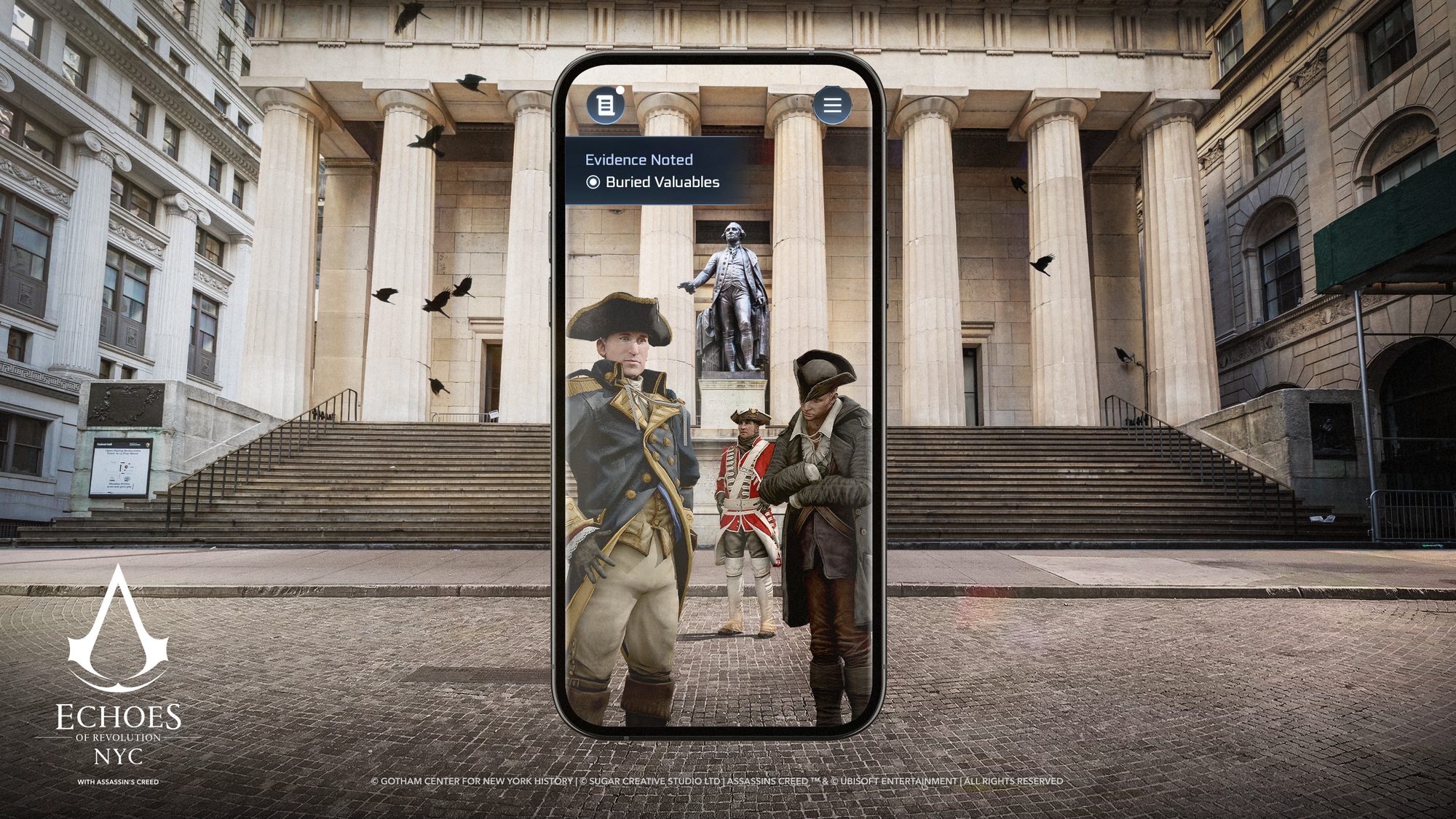
New York may simply be further along the curve. What is becoming a challenge for many American cities has been a reality here for generations. The Revolution helped create modern New York. Now New York is helping to create new ways of experiencing the Revolution, ways that don't require cobblestones, that can follow people into neighborhoods where the 18th century isn't on display, and that can reach students who arrived here from elsewhere and are still learning what it means to be part of this place.
For a city often accused of forgetting its past, that may be the most revolutionary thing of all.


