

A data-driven roadmap to addressing ‘high-acuity’ homelessness


In her recent Vital City essay, “A Department of Community Safety: Theory Meets Practice,” Gloria Gong captures a hard truth about New York’s homelessness and mental health crisis: “Compassionate crisis response is essential, but without relentless follow-up, people spiral right back into the same subway stations and emergency rooms.” This is exactly the missing layer of coordination and accountability that the Collaborative on Housing for Health (CH4H) aims to address.
This Collaborative, which we help lead, is a coalition of some of New York’s largest health, housing and human-services providers working in partnership with the Department of Social Services (DSS) to better understand a specific challenge we call “high-acuity” homelessness. This term describes a cycle that can occur when people without stable housing experience significant behavioral health issues and move between streets, shelters, hospitals and jails. When someone experiencing homelessness gets caught in this cycle, it can worsen their preexisting health problems and make it all the more difficult to reach stable housing. Our newly released roadmap effectively writes the next chapter to Gong’s argument: how New York can move from reactive crisis response to sustained system coordination that serves New Yorkers with the most complex needs.
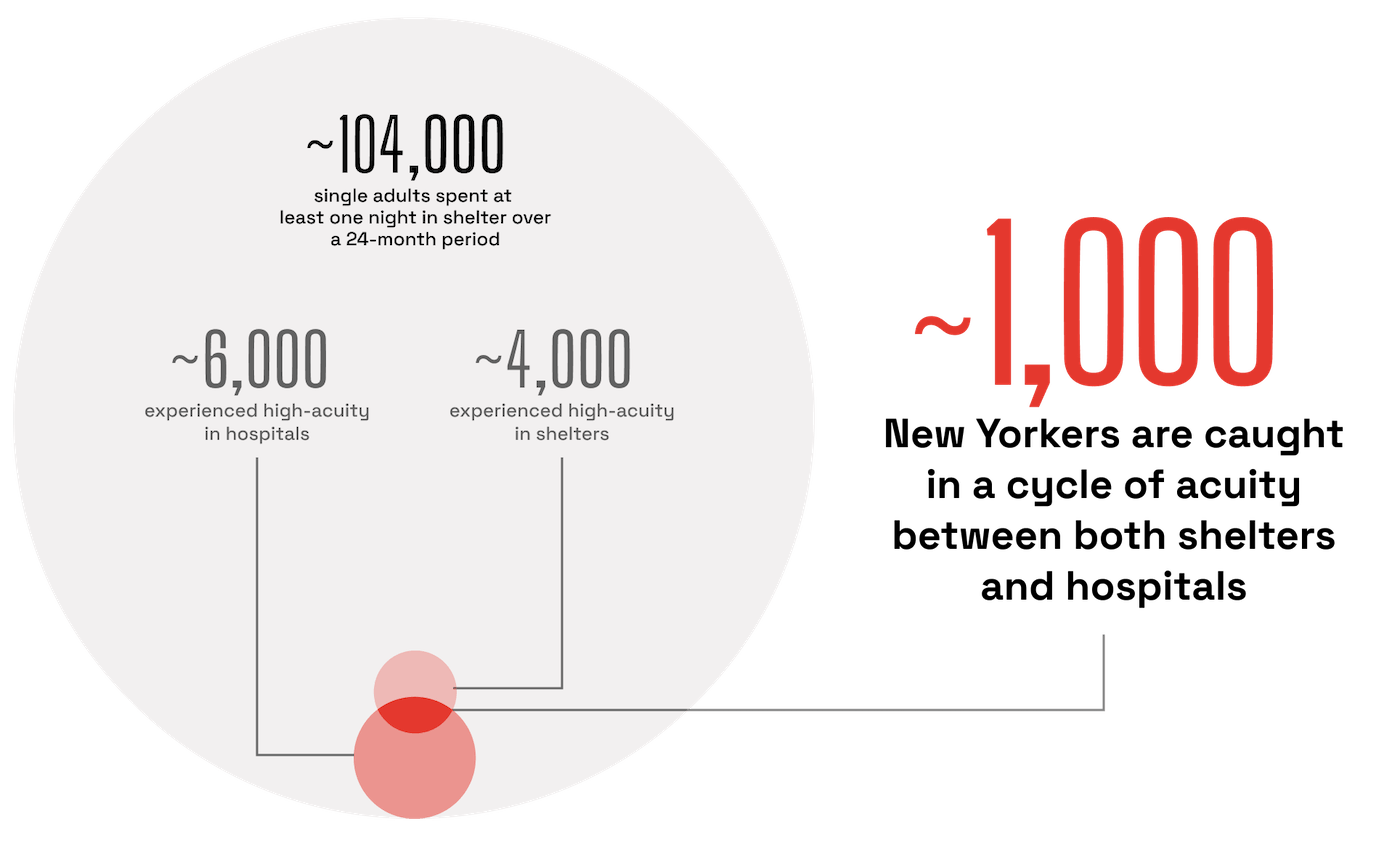
In a city with vast resources and decades of investment in homelessness services, many New Yorkers understandably ask why so many people are still visibly struggling and unhoused. One key reason is that, over the past several decades, the nature of homelessness has changed. While 97% of New Yorkers experiencing homelessness are stably connected to shelter or transitional housing, a small subset of single adults in the system face far more complex behavioral health needs that can drive cycles of crisis.
The system designed to support people has not kept pace with this changing demand. Much of New York’s supportive housing and behavioral health infrastructure was built to address psychotic disorders such as schizophrenia. Today, however, a significant share of adults experiencing homelessness live with co-occurring complex challenges — layering health-related conditions brought on by deep histories of chronic trauma and homelessness, compounded by behavioral health conditions such as personality disorders and substance use disorders.
These conditions require very specialized kinds of care. Whereas individuals with psychotic disorders often respond well to medication paired with therapy, many increasingly common behavioral health conditions can cause rapid shifts in mood and difficulty maintaining stable relationships with care teams, making them more challenging to serve with traditional supportive housing models. What they often need instead is specialized psychotherapy as the primary treatment, combined with steady, long-term support. This requires sustained engagement to help individuals move along a long, nonlinear path toward stability. Without that, they are more likely to cycle between public systems not designed to serve them.
The City’s data shows this pattern playing out. About 1% of individuals in the shelter system — or about 1,000 individuals over a recent two-year period — account for a vastly disproportionate share of crisis system use, cycling repeatedly through shelters, emergency rooms and short jail stays — at immense human, health and financial cost. This finding comes from a novel DSS analysis linking data across hospitals, shelters and jails. The insight is crucial: There is a finite, knowable population, not an abstract or unbounded challenge.
In interviews with more than 60 people who have experienced homelessness, the Collaborative heard stories that bring the data to life. Many described being discharged from hospitals or jails directly back to the streets, with no continuity of care and no clear pathway to stability. “It was so frustrating and exhausting to go from the hospital to the streets or from the hospital to a traumatic shelter because I would always end up right back in the hospital,” one participant told us.
Again and again, people described seeing not the continuous, coordinated care they needed, but a series of program hand-offs, “discontinuations” for noncompliance and long stretches of falling through the gaps between criminal justice, health and housing systems.
The analysis also reveals system gaps that keep people stuck in crisis. Many people leaving jail get almost no support reconnecting to housing or treatment. The city lacks sufficient psychiatric beds and step-down programs, so people who need ongoing care cycle back through emergency rooms.
All of this is happening despite the best efforts of thousands of skilled, dedicated City and nonprofit provider staff. The problem isn’t a lack of commitment or that existing programs don’t help people. It’s that the system doesn’t give providers what they need to succeed with the highest-acuity New Yorkers, and most programs were never designed to offer the kind of tailored, continuous support this population requires.
Making matters worse, providers face real disincentives: It is hard work to serve people with high-acuity health needs in programs lacking the structures to do so successfully. This work can lead to staff burnout, and the system rewards programs for delivering a service, sometimes regardless of whether someone actually achieves long-term stability. These barriers stem from how the system is structured, not primarily from lack of resources — and, in some ways, in spite of increased public resources.
In recent years, significant investments — particularly the state’s historic commitment to expanded mental health services — have added important new programs and resources to the system. These investments represent real progress and have brought much-needed capacity to areas in need of support. At the same time, the growth in programs has not yet been matched with stronger coordination among them, as no single entity is responsible for helping people move from crisis settings to treatment and housing. Improving handoffs between programs is essential to maximizing the impact of these investments.
At the city level, New York has also made significant strides toward creating the kind of continuity this population needs. For example, the City has expanded Intensive Mobile Treatment (IMT), a model that stays with a person across settings, providing long-term, flexible care through hospitalizations, incarceration or street homelessness. Major providers, including one of our organizations, the Institute for Community Living, have developed step-down programs that bridge people from IMT to community-based services. These models show what’s possible when care is continuous and coordinated, but they only reach a fraction of the New Yorkers who need that level of support.
Together, our quantitative and qualitative insights point to the same conclusion that Gong articulated: The fundamental challenge is that there is an absence of any single accountable actor responsible for follow-through in the hardest cases. The solution is to realign existing programs and funding streams so providers have the accountability, flexibility and incentives they need to succeed. The Collaborative on Housing for Health has developed and will test a model designed to do that, right now, using the tools we already have. We call it a “service pathway.”
The service pathway is the Collaborative’s signature innovation: a practical but ambitious way to knit together the city’s existing programs and services to meet people where they are and support them long enough for recovery to take hold. Under the model, one qualified nonprofit provider, known as a “pathway lead,” will take full responsibility for serving a defined group of high-acuity New Yorkers from the moment they’re identified through stabilization in permanent housing. For example, when someone is discharged from the hospital, the pathway lead will immediately connect them to housing, schedule mental health appointments and support them so they actually attend — rather than handing them off to another agency.
Crucially, the same team will stay with that person through crisis, transitional housing and into permanent supportive housing, filling the gaps people currently fall through. Cross-agency contracts will make those responsibilities clear and trackable, with the goal that no one slips back into crisis. And most importantly, organizations will be held accountable for outcomes, rewarding prompt responses, reduced crisis use and stable housing rather than simply counting services delivered. This is a major shift: For the first time, there will be a single point of accountability to own the most complex cases and support someone’s full journey out of crisis.
The service pathway model will also give providers the tools and shared criteria they need to recognize when someone is experiencing high-acuity homelessness and connect them to the right level of care. Today, frontline staff lack both a common definition and practical ways to identify these cases. Every time a person experiencing high-acuity homelessness walks into an emergency room or is discharged from a jail, this is an opportunity to intervene with a connection to robust support before the next crisis. Under the service pathway model, high-acuity cases are defined consistently across common crisis points. Data can then be linked and surfaced through existing systems to help route people to specialized services more quickly and effectively.
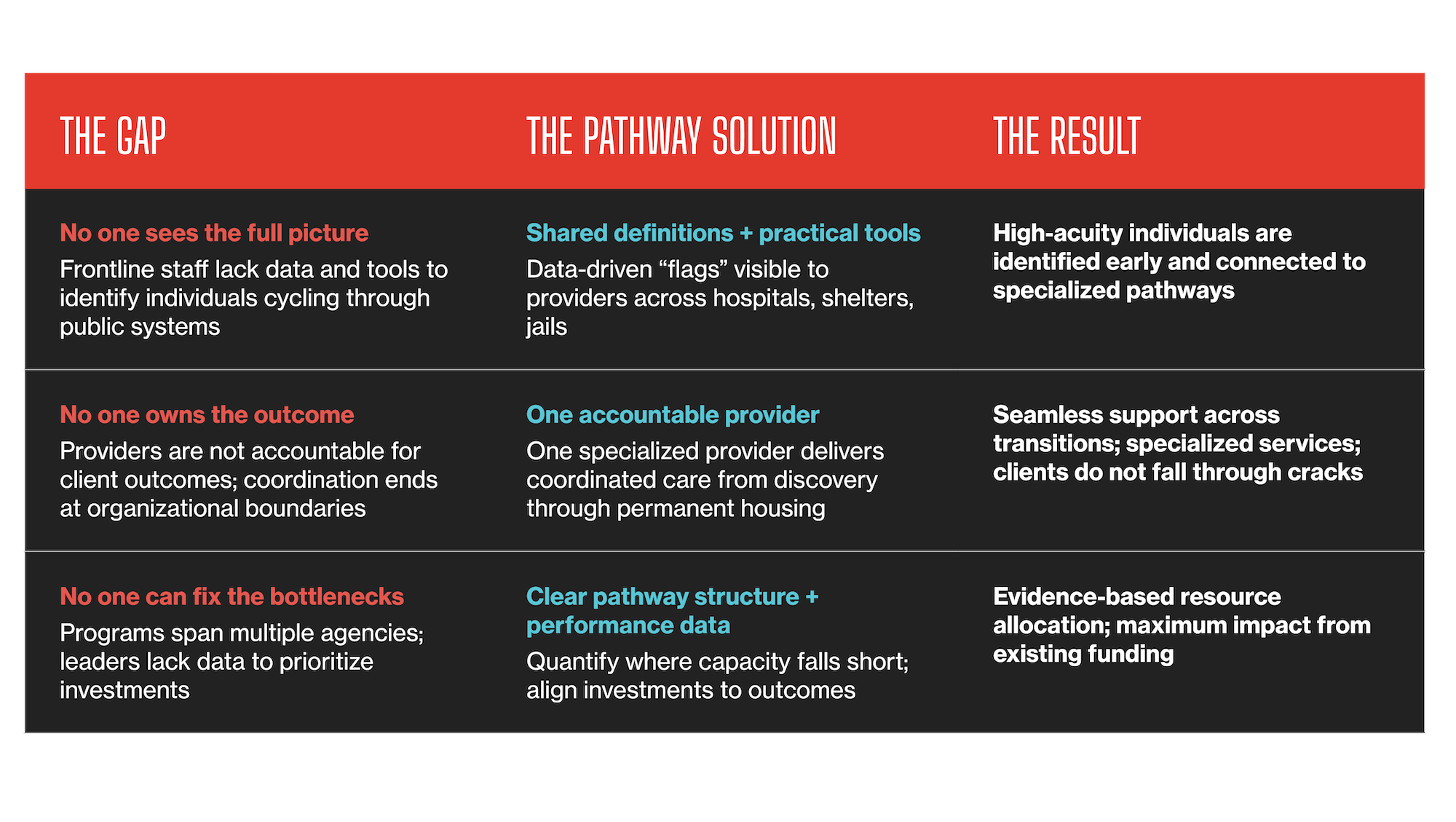
The service pathway approach will soon be piloted through a partnership between DSS, the Collaborative and leading nonprofit providers, with support from The Leona M. and Harry B. Helmsley Charitable Trust. The pilot will test how service pathways can integrate funding streams, align accountability and demonstrate measurable results for the people most visible — and most let down — by our current system. To inform future policy changes and public investments, we will also map the supply of housing and services against the needs of individuals in acute crises, making bottlenecks visible and quantifiable. By bringing together major housing and service providers with the resources to address a challenge that cannot be solved by any single agency, this pilot will serve as an incubator for system innovation. Over the long term, its successes could be replicated across broader populations.
Now is a rare moment of opportunity for New York to tackle high-acuity homelessness: Federal budget cuts and fiscal constraints are placing increased focus on cost-effective solutions, momentum is building across the field to close long-standing gaps in care for this population, and political attention to behavioral health and public safety is intensifying just as a new mayoral administration prepares to take office. This is the moment for transformation.
The infrastructure is already in place: The data systems, the provider network and the funding streams all exist. What’s needed now is alignment — a shared expectation that the highest-need New Yorkers are not “too hard to serve,” but too important to leave to chance.
Compassionate crisis response, as Gong wrote, must be matched by persistent follow-up. The service pathway model delivers exactly that: one accountable provider, coordinated care from crisis to housing and the realignment of existing resources around outcomes rather than activity. And it speaks to something all New Yorkers share — a belief that no one should be left to struggle alone in a moment of crisis, and our support system should give our neighbors with the greatest needs a real chance at recovery.
The article you just read took weeks of research, interviews with experts, and careful analysis. It's the kind of rigorous, solutions-focused work that takes time, and support from readers like you makes it possible.
Vital City launched three years ago on a bet: that New Yorkers craved calm, evidence-based ideas in a hyperpartisan moment. You proved us right. And together, we've built something rare: a civic institution that influences policy without ideology.
To meet this moment, we need to grow, and we need your help to do it.
Your gift will help us expand our operational capacity, and publish more of the practical policy ideas that are cited by decisionmakers, used in college classrooms, and referenced on the campaign trail.
Will you join us?