


It’s a corrosive phenomenon with one side benefit.
Let's stipulate at the outset: Partisan gerrymandering — whether in Virginia or Florida — is bad for democracy. In recent years, increasingly sophisticated computer models have enabled ever more aggressive line-drawing, which the Supreme Court has repeatedly allowed, steadily widening lawmakers’ power to choose their voters rather than the other way around. The result dilutes minority voting power, makes it harder for elected officials to serve constituents with coherent shared interests, can effectively silence entire state delegations when partisan control of the House shifts, weakens public trust in elections and leaves entire communities without a meaningful voice. That’s a tragedy.
But it’s a tragedy with one potential, albeit small, saving grace: In their efforts to crack and pack urban voters to dilute their influence in elections, Republican-friendly mapmakers sometimes end up spreading those voters — and their cities' challenges — across multiple congressional districts. Even when those districts are represented by people whose main center of gravity politically is in exurbs or rural areas, that can create broader political ownership over the kinds of issues that are often concentrated in urban centers, including public safety, housing instability and reentry after prison. The same effect occurs with Democrat gerrymanders, as the Virginia redistricting scheme struck down by the state’s top court would have doubled the number of districts that include a piece of the Washington D.C. metro area.
Consider Memphis and New Orleans, two cities frequently cited when national conversations turn to violent crime. Both cities have populations below the target district population of 761,169 per the 2020 census. Under relatively compact, geographically sensible maps, each could have a single House member who would presumably advocate for federal investment in crime prevention, reentry programs or housing stability. But now both cities’ populations are being carved up and scattered among multiple congressional districts by their state legislators. And so, where once there was one lawmaker with a stake in what happens on Beale or Bourbon streets, now there are two or three. Even if that makes the city itself less powerful in Congress, it will give multiple legislators with a wider ideological range a shared, if less significant, stake in the city’s future. And as a result, that’s likely to get those legislators more involved in figuring out how to solve problems in those cities — as opposed to sitting on the sidelines and pointing fingers at members of the other party who are allegedly failing at the job.
That broader stake extends beyond housing. Crime, of course, is hardly an exclusively urban phenomenon. Rural areas face significant challenges related to drug addiction, property crime and violence. Suburban communities grapple with fentanyl overdoses and gang activity that don't stop at the county line. But perception often lags behind reality in politics, and the perception — fueled by selective media coverage and decades of political rhetoric — is that serious crime is primarily an urban problem.
When suburban or exurban members of Congress suddenly find that portions of Memphis, New Orleans, Birmingham or Indianapolis fall within their district lines, they gain a new constituency — and with it, a new political incentive to care about what happens in those communities. Lawmakers who previously thought they had little reason to champion grants for violence interruption programs or DNA testing backlogs now have constituents who need those things. They may not be the constituents who are controlling primaries or general elections, but they are constituents nonetheless.
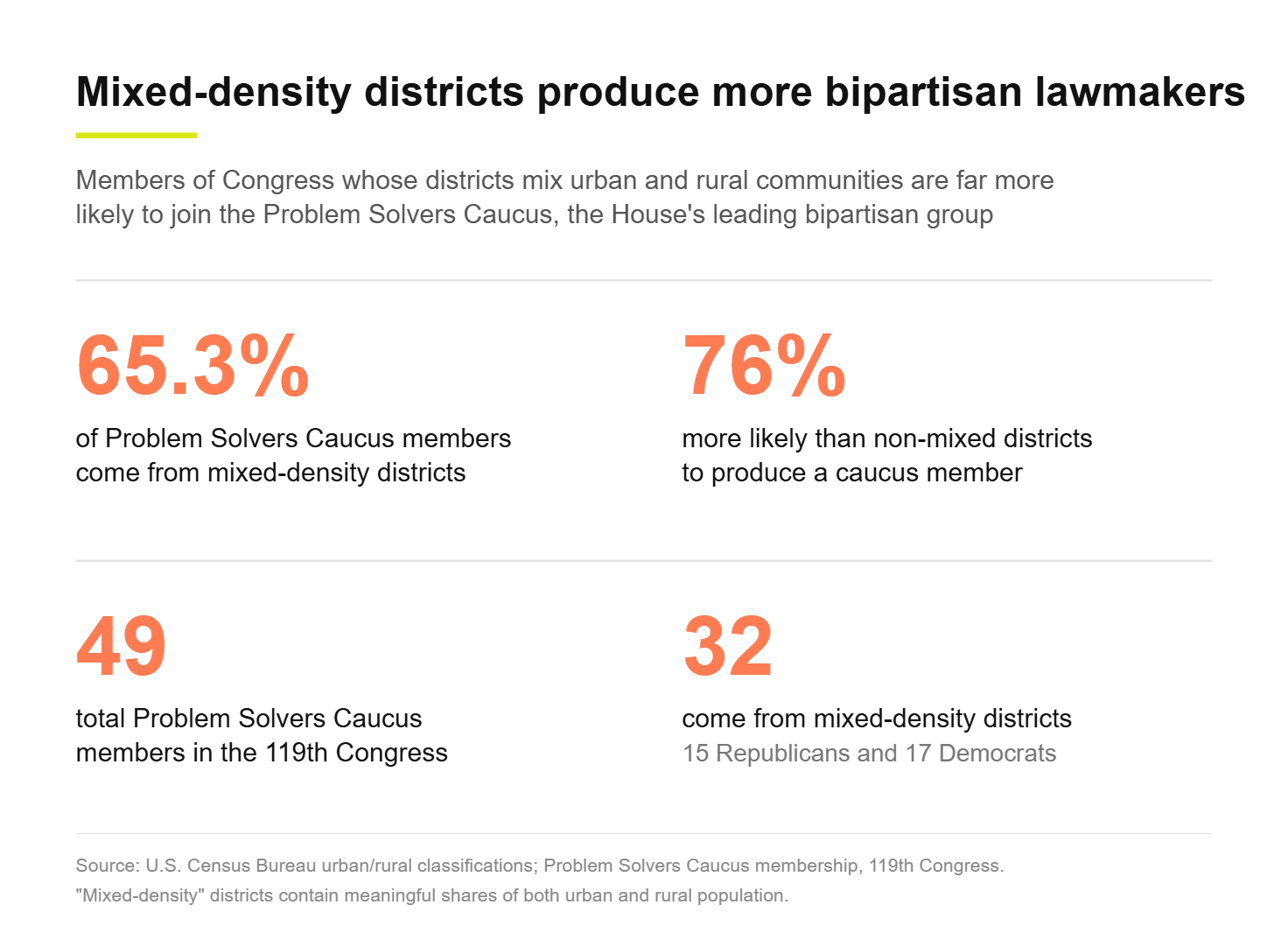
Moreover, research has shown that members from districts that have communities of varying population density may be less ideologically rigid and more inclined towards crafting bipartisan solutions. Indeed, members from districts with more than one type of population density are 76% more likely to participate in the Congressional Problem Solvers Caucus (PSC), the leading bipartisan legislative caucus.*
The implications for federal criminal justice policy are already significant. The Department of Justice's Office of Justice Programs administers hundreds of millions of dollars annually in grants for purposes ranging from solving cold cases to funding pretrial diversion programs and supporting crime victims. Support for some of these initiatives has been eroded over the last year. Historically, competition for such funds has been skewed toward states and localities with more members on key appropriations subcommittees — members who, by virtue of their districts, have had a reason to prioritize them. Now that gerrymanders have resulted in more House members having a direct stake in the fortunes of major urban centers, the political math around those appropriations is beginning to shift.
The same logic applies to housing policy. Urban housing instability and crime are deeply interconnected, with research consistently showing that stable housing reduces recidivism, and that concentrated poverty drives cycles of violence that neither policing nor social services alone can break. When lawmakers representing prosperous outer-ring suburbs now also represent inner-city neighborhoods where constituents’ adult children struggle to find affordable housing after release from prison, the dynamics of the policy conversation has already started to change. Abstractions become constituents. It also turns out free-market policies championed by many conservative lawmakers are crucial to removing the red tape of permitting and zoning that inflates housing costs, a reality that the abundance movement on the center-left has recently embraced to a considerable degree.
None of this is to romanticize gerrymandering or suggest that a corrupt process can be relied upon to produce good outcomes. The distortions it creates in competitive elections, minority representation and democratic accountability are serious, and no accidental urban policy benefit comes close to justifying them. Independent redistricting commissions and statutory constraints on partisan line-drawing remain the right goals. All who care about the future of democracy should want the Supreme Court to reverse its corrosive recent precedents.
But while we’re waiting for what may be an unlikely outcome, policymakers and advocates working on criminal justice reform and urban revitalization would be wise to seize the opportunities created by a new congressional map that gives more members a direct stake in our nation’s urban areas. If members who previously never would’ve attended a briefing on hotspot policing or violence interruption programs now have constituents in Memphis waiting for an answer, that briefing should become worth their time. If the representative of a safely red exurban district now also represents part of New Orleans, the incentive may be greater to advocate for initiatives like grants funding DNA testing that can both solve more crimes and identify those wrongfully convicted.
Innovative state-level initiatives offer a compelling model for what federal investment could look like. In Utah, a bipartisan bill created the Violent Crime Clearance Rate Fund, a grant program with matching funds provided by Arnold Ventures that helps law enforcement agencies solve violent crimes by increasing officer ranks and investigative resources. Such interventions already have bipartisan support, but they could find new champions among members of Congress who, thanks to gerrymandered maps, suddenly represent parts of urban communities that may be more likely to live with the consequences of unsolved violence.
Nor should we overlook the electoral dimension at the heart of the new map. The presence of newly incorporated urban voters matters not only in general elections — where shifting demographics could make some suburban or even historically red districts competitive in a national wave environment — but also in primaries. The objection here is obvious: Aren’t some gerrymandered districts designed precisely to ensure those urban voters are too few to matter? In states with closed primaries, it’s true that the majority of urban residents who are Democrats can’t vote in Republican primaries. But, even if the urban area incorporates only 10 or 20 percent of the primary electorate, that could sway a tight race.
Even if the chances of that are modest, lawmakers may feel obliged to attend to the concerns of their constituents. Consider Tennessee’s 8th Congressional District. That district — rated R+21 and among the most reliably Republican in the South prior to the 2026 Tennessee gerrymander — included numerous suburbs in Shelby County, all of which are urban areas. Kustoff voted for the First Step Act in 2018 and for the EQUAL Act in 2021 — the bill eliminating the federal sentencing disparity between crack and powder cocaine — both votes that divided Republicans. And in 2025, he spent a day alongside the Trump administration’s Memphis Safe Task Force and began pushing for a permanent federal law enforcement presence in the city, explicitly citing the need to address violent crime for his constituents.
We’ve seen signs that such a dynamic can work even in a Congress that many consider hopelessly divided. A close look at the 2018 First Step Act, the landmark federal criminal justice reform bill that has reduced recidivism among people released from the U.S. Bureau of Prisons, bears out the logic. The act, which reduced some mandatory minimum sentences in the federal system and expanded rehabilitative programming, earned overwhelming bipartisan support.
But analysis of the House revealed a clear pattern: Republicans representing districts with any urban component were significantly more likely to vote for the First Step Act than those from entirely rural or exurban districts. Of the 36 Republican “no” votes, nearly all came from the most rural, heavily conservative districts. Conversely, Republicans whose districts included parts of cities — even if those districts were drawn to be safely red — voted “yes” at more than three times the rate (94% versus 29%) than their rural counterparts.
If the First Step Act, which focused on sentencing and prison reform, produced such a clear correlation, there is good reason to expect an even stronger effect for legislation aimed at grant programs to prevent and solve violent crimes. Violent crime is a visceral, immediate concern for urban constituents. Lawmakers who know that a portion of their primary electorate lives in a high-crime neighborhood might think twice before opposing funding for DNA testing backlogs, violence interruption programs or state grant initiatives like Utah’s violent crime clearance fund.
Recognition of this silver lining is not a call for complacency about gerrymandering's real harms. It is an argument for clear-eyed opportunism in policy advocacy. Sometimes democracy's distortions create unexpected openings. The challenge is whether our elected leaders choose to walk through them.
*Analysis performed using 2026 Congressional District Health Dashboard (CDHD) District Density Index that categorizes congressional districts into six types based on a gradient of household density: Pure Urban: Highest household density, Urban-Suburban Mix Dense, Suburban Sparse, Suburban Rural, Suburban Mix, Pure Rural: Lowest household density.
** Analysis performed using 2018 CDHD data.
Marc A. Levin, Esq., and Khalil Cumberbatch co-lead the Centering Justice Initiative at the Council on Criminal Justice, where Levin is Chief Policy Counsel and Cumberbatch is Director of Engagement and Partnerships. They can be reached at mlevin@counciloncj.org and khalil@counciloncj.org.


