


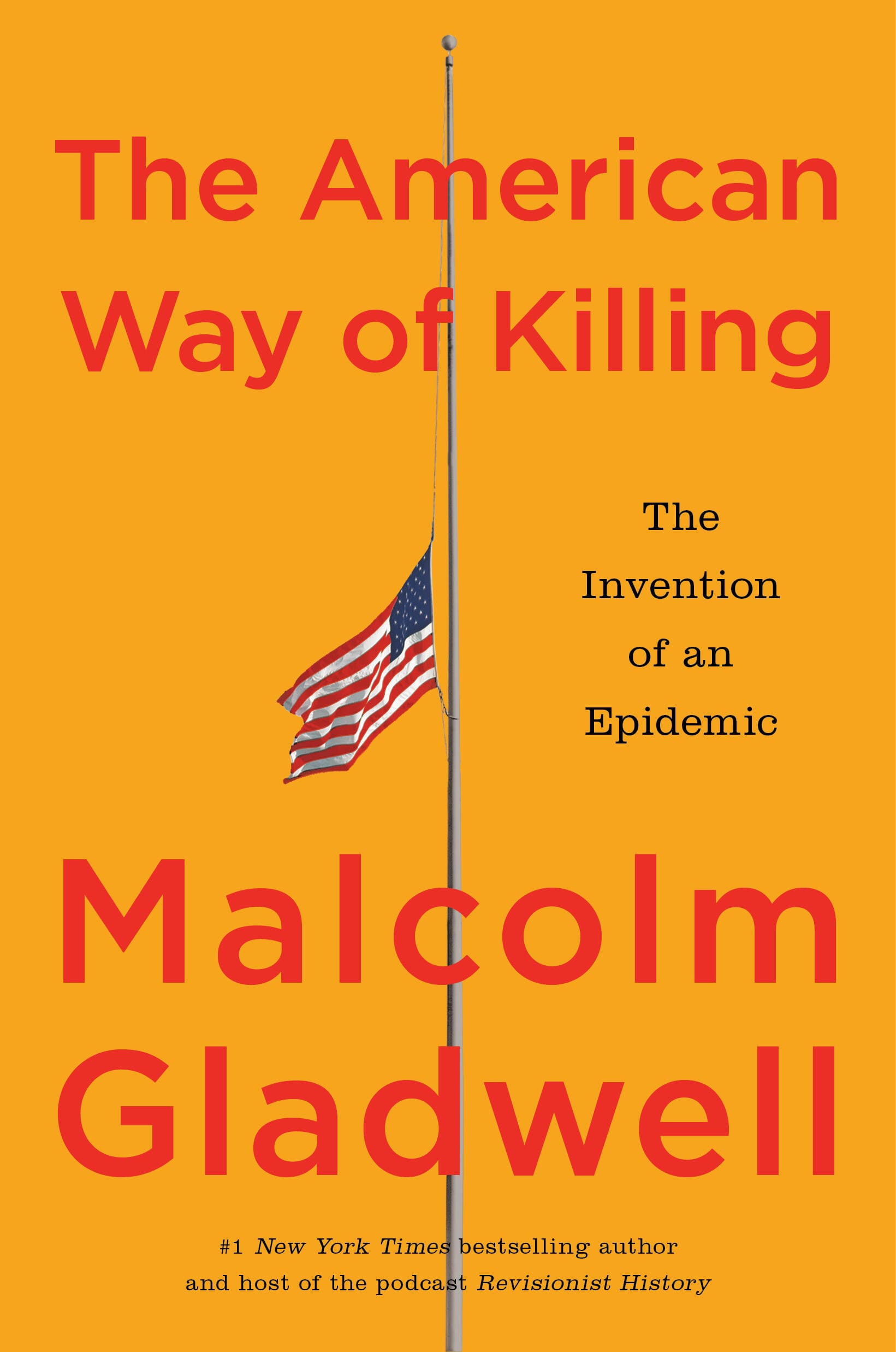
On Malcolm Gladwell’s latest book, “The American Way of Killing”
Malcolm Gladwell has done it again. He’s written another engrossing and edgy book that is going to entertain, inform and irritate his readers in equal measure. And it will have a lot of readers — his previous eight books have sold over 10 million copies worldwide. This time, in “The American Way of Killing,” his focus is on lethal violence in America, and the fact that there is so much of it in comparison with the rest of the developed world. How should we understand this tragic sort of American exceptionalism?
Gladwell grew up in Canada, and though he’s spent most of his adult life in the United States, he still recalls his first impressions (from the pages of Life magazine) about how much more dangerous it was south of the border. That “violence gap” remains: In 2024, for example, the U.S. homicide rate was 5.9 per 100,000 residents, over three times as high as the Canadian homicide rate of 1.9. Almost all of this difference is due to the much greater use of firearms in U.S. criminal assaults. (The non-gun homicide rates in these two nations are close to equal.) The U.S. homicide rate leads those of most other wealthy nations by a still wider margin.
Gladwell doesn’t provide a systematic explanation, but does have much to say about the prominent role of firearms. “Guns are the most distinctive feature of American life: No other country has such a wide variety of firearms owned by such an enormous share of its population.” And in that regard, he structures the book around three conclusions: Americans are dishonest in how they talk about gun violence. Americans don’t understand the nature of their problem. And Americans have chosen a path with respect to firearms that is “morally reckless.”
These are rather vast generalizations, referencing “Americans” as an undifferentiated mass and a clueless one at that. I’ve been researching American gun violence and its prevention for 50 years, and I can confidently say that there is no consensus of the sort that he attributes to “Americans.” Indeed, Gladwell borrows from American scholars, and some of his conclusions would, I suspect, be endorsed by the majority of Americans. If the country has “lost its way,” as he observes, the explanation has much to do with how power is distributed and exercised, rather than a uniform wrongheadedness. But that sort of political analysis will have to wait for another book. The book Gladwell did write has much to offer.
I will recap the highlights of each of the three parts, and along the way provide some commentary about hits and misses. Looking ahead, I would wager that where this book may be most impactful is in Part 2, where he makes a case for greatly increasing the number of police. Indeed, that was the section that he serialized in a recent issue of The Atlantic. Stay tuned.
In Part 1, on the dishonesty of our conversation about guns, he balances his indictment by attacking both the right and the left. He ridicules the left’s call for a ban on assault weapons, suggesting that a military-style semi-automatic rifle is no more deadly than any other firearm. (He does not address the fact that these weapons can be equipped with 100-round magazines, and converted to full auto using an aftermarket “sear.”) On the right, he goes after the 2008 Supreme Court ruling in the Heller case, where a majority of justices somehow discovered for the first time that the Second Amendment of the U.S. Constitution guarantees a personal right to keep and bear arms — despite previous Court rulings, and historical and grammatical evidence, that it was really intended to protect the right to organize militias. (Gladwell adopts the interpretation of law professor Carl Bogus, who made the case that the historical purpose of the Second Amendment was to reassure slave owners that they could continue their organized patrols to apprehend runaway slaves — a necessary condition for persuading the Southern states to ratify the Constitution. Other scholars agree with the “militia” interpretation, but have provided a more nuanced account of this history.)
Part 2 is organized around the assertion that Americans don’t understand the nature of gun violence. Gladwell adopts the compelling argument most recently developed by University of Chicago professor Jens Ludwig (a frequent contributor to Vital City) in his book “Unforgiving Places,” to the effect that while some homicides are instrumental to achieving the killer’s purposes, most are “expressive,” a spur-of-the-moment attack in the midst of an argument. Adrenaline, alcohol and a readily available gun all tend to play an important part. This image of the typical homicide would surprise most Americans, he says, and has implications for violence prevention strategy. People overcome with violent impulses may not be sensitive to remote legal consequences. But restrictions on gun carrying can make a real difference, and so can evidence-based programs that help at-risk youths keep their heads in conflict situations.
With respect to criminal justice policy, Gladwell endorses the widespread view among criminologists that violent crime is more readily deterred by increasing the likelihood of arrest and conviction than by longer prison sentences. And he takes that argument in a surprising but logical direction, namely towards the conclusion that America’s police forces are too small relative to the burden of violence. He reports that overall criminal justice spending is similar in the U.S. and Europe, but with a huge difference in how the money is spent: Europe spends five times as much on police as on prisons, and the reverse is true in the United States. The police in the U.S., he says, are “completely overwhelmed,” and the result is low arrest rates and even police misconduct. He argues that Defund the Police, the motto that was widely voiced in 2020 following the murder of George Floyd, is a misguided approach that risks making a bad situation worse.
The most credible research provides general support for his conclusion about under-policing. I would add that it’s not just a matter of increasing the size of police forces, but also making violence prevention the highest priority. Researchers at Penn’s Crime and Justice Policy Lab and elsewhere have developed and tested an array of violence reduction tactics, guided by the observation that lethal violence is very heavily concentrated in particular neighborhoods and among particular individuals. Police departments are paying attention, with good results. Also of interest are the police-adjacent programs adopted by a number of cities that provide for an unarmed response to 911 calls for mental health crises and other problems where the power to arrest is of little use; among other things, these free up police resources for patrolling “hot spots,” intensifying investigations of shootings and running “focused deterrence” programs against high-risk individuals.
Gladwell again balances the ticket, advocating not only for more police but also for more investment in prevention programs. He offers a full-throated endorsement of Becoming a Man, a school-based program that seeks to help at-risk adolescent males with emotional regulation, decision‑making skills and tactics to avoid unnecessary conflict. He quotes from his interviews with Jens Ludwig, who has led several large-scale randomized controlled trials that provide strong support for the efficacy of this program in improving school and criminal justice outcomes.
While agreeing with much of this, I think it’s fair to contest Gladwell’s overall thesis for Part 2. Americans — or at least key leaders in government, policing and academia — do have a pretty good understanding of gun violence in America. While still high by international standards, the U.S. homicide rate in 2026 is on track to be the lowest in our recorded history, having dropped precipitously since 2022. Well-targeted policing and violence-prevention programs deserve part of the credit.
Part 3 of the book focuses on the Supreme Court’s 2022 Bruen ruling, which extended the newly established Second Amendment right for individuals to “keep and bear arms,” negating a century-old New York state law restricting the carrying of guns in public. Gladwell provides a fascinating account of how the majority opinion relied on a misconstrued bit of English history from the 1600s to reach what he deems to be an absurd decision, and one that is “morally reckless.” To illustrate what is lost from this decision, his epilogue recounts the story of Dodge City, a cow town in western Kansas that became famous in the 1870s for high rates of gun violence (“time to get out of Dodge”). The town fathers solved the problem by hiring a sheriff and a number of deputies, and banning the carrying of firearms in city limits. In his telling, this story — problem solved! — serves as a sort of parable for what could be done if America as a whole would get its act together.
In recounting the high points of Gladwell’s book, I skipped an idiosyncratic detour he takes in Part 1, concerning the importance of trauma care in understanding trends and patterns in U.S. violent-death rates. In the “hits and misses” scoring, I would count those views as decidedly “misses.” Gladwell cites an article with the bombshell finding that, were it not for improvements in trauma care from 1960 to 1999, the homicide rate would have been at least three times as high as the actual rate at the end of that period. The authors of that study simply compared the strong upward trend in aggravated assaults, as reported by the FBI, with the modest changes in the homicide rate, and concluded that the best explanation for the resulting decline in the case-fatality rate was improvements in medical care. But there is another explanation, namely that the trend in aggravated assault during those years is an artifact of improvements in data quality, and in particular a large increase in the likelihood that threats and attacks would be reported by the victims, recorded by the police department and forwarded to the FBI. (If the authors of that study had used the trend in assault-rate estimates from the National Crime Victimization Survey, which is not subject to this trend in reporting, they would have reached a far different conclusion about the case-fatality rate.) The too-good-to-be-true claim that the data imply a vast improvement in trauma care must give way to a more boring conclusion about improved crime reporting.
To be clear, it’s not that improved trauma care has made no difference during this period, but that the plausible effect is small, being limited to the marginal cases where the attack leaves the victim alive but grievously wounded. (And there is a countervailing trend that may swamp even those marginal gains in the case-fatality rate: The firearms typically used in gun assaults have become more powerful and hence more lethal during this period.)
Gladwell’s other eye-popping claims about case-fatality rates do not stand up to serious scrutiny either. He says that the huge Black-white disparity in homicide rates (a factor of seven) may be accounted for by the slower EMT response times to Black neighborhoods, and that the male-female disparity in homicide rates (a factor of four) may have a lot to do with testosterone somehow interfering with the medical recovery from a gunshot wound. Interesting speculations, with perhaps a grain of truth, but they at most account for a small fraction of the observed disparities in death rates.
Indeed, I was inspired to download the last 10 years of data on shootings in Chicago and compute case-fatality rates. It is true that they are higher for men than women, but just barely: 23.1% vs. 21.8%. It is also true that Black shooting victims have slightly higher fatality rates than white (including Hispanic): 23.2% vs. 21.7%. These small differences cannot begin to account for the huge gaps in the homicide rates with respect to victim sex and race. We are left with the conclusion that these gaps in homicide rates are primarily the result of the fact that Black people are much more likely to be shot than whites, and men far more often than women. The difference in death rates is largely proportional to the shooting rates.
Enough on his odd detour into trauma care. Let me sum up the big picture. Gladwell does not set out to provide a systematic blueprint for reining in gun violence in the United States. He clearly favors regulations to keep guns out of public places, and, relatedly, an end to the “morally reckless” approach to interpreting the Second Amendment. More generally, he supports measures that he believes would help reduce violence generally — a large increase in the number of police, perhaps coupled with reduced prison sentences, and the widespread adoption of prevention programs intended to help kids avoid violent conflict. At heart, however, this book is not a prescription for policy, but a plea to change the conversation about gun violence, and in particular to abandon the myths about history and the nature of lethal violence that he argues have led us down the wrong path. Gladwell is an imperfect guide to a better path, but he provides a wealth of memorable ideas, anecdotes and interviews, and the trip is well worthwhile.


